Why it’s okay to feed birds in your Australian garden and how to make it a guiltfree practice.
It’s a thing that seems uniquely Australian. An extremely negative reaction to feeding the birds. Overseas it’s accepted practice. It’s even encouraged during long, cold winters. Not so in our sunburnt country. The reasoning?
They’ll become reliant on the food source and starve if you stop feeding them.
Possibly, but surely a species that is used to foraging will still be able to find other sources?
They’ll catch diseases from each other.
You’re right. Birds do congregate where there’s food. Not just at my place either. How can we stop them all feeding from the same tree that has burst into flower? How can we stop them investigating the same tree hollows, especially with availability of hollows diminishing with development and habitat clearing?
These arguments sounded a bit hollow in the clashing abundance of negativity so…
So, I used to be quiet about my birdfeeding habit. I felt guilty, like it was something to be ashamed of. As if it were the same as smoking cigarettes or drinking too many glasses of wine every night. Doing damage but doing it anyway…
No matter how guilty I felt, the joy from the action was too great to resist. The birds come close. I can see them. I can see individual feathers and their beaks in detail. I can recognise some as individuals.
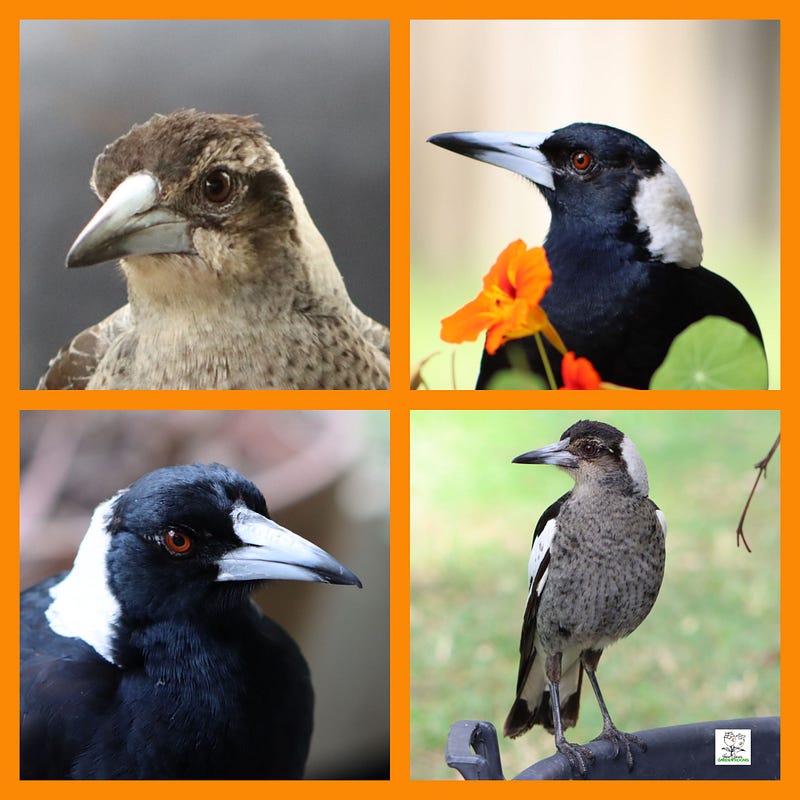
Our resident magpie family actively communicates with us. It’s lovely, despite the shock of having a Magpie suddenly land right beside your head while you’re watching something on your phone on the back patio. There’s the boss, Mother Magpie, called Zara by my daughter. The father, named Henry Trotter by my son, defers to her but struts around with dignity. The children, two in most seasons, squabble with each other. There’s always a needy sibling calling all the time and a more independent sibling that struts like Dad. Two years ago, a noisy sibling, Anastasia, didn’t want to leave the territory and would sit next to us and warble for food after being chased by her parents.
Then, I discovered an interview with Daryl Jones, urban ecologist and author of “Feeding the Birds at your Table: a guide for Australia”, now on my future reading list.
He had conducted a study on bird feeding which had transformed him from anti-birdfeeding to enthusiastic birdfeeder. His argument, compelling and sensible, centres around: people are going to feed the birds, so let them, but educate them so that it benefits the birds! He likens it to having the birds visit for a cup of tea and a biscuit. Here’s a link to the interview if you’re interested https://www.abc.net.au/radionational/programs/lifematters/is-feeding-birds-australias-most-guilty-pleasure/11566582.
It’s not about not feeding the birds, it’s about feeding them the right foods, maintaining hygienic conditions and enjoying it for the healthy connections it builds.
I buy appropriate seed and share appropriate scraps. I even bought an insectivore mix one day… the insectivores ate a little bit, but seemed less than impressed. It’s probably like having old tasteless fruit after a lifetime of plucking it free from the orchard.
I feed them on the grass and I try to spread it around to different patches every day.
If we get a visit from a bird that looks like it has a disease, I feel awful as I stop feeding them for a week to discourage congregations.
I plant native bird-friendly plants for seed-eaters, insectivores and nectar-feeders. I use no pesticides and watch the birds feast on caterpillars and grasshoppers.
I am passionate about respecting and saving nature. I wonder if it’s because I was always encouraged to connect with the wild species around me? Anyway, I am a bit addicted to connecting with nature. It infuses me with happy calm (contentment?) and sometimes excitement. It’s a crucial support for my mental health.
Anyway, it’s my healthiest addiction, so why would I quit?

 Jane Grows Garden Rooms