Photo a day challenge — Week 20: April 1st to April 7th, 2022
I am cheating with my feature shot this week and one later in the piece. I am selling off my old camera and so I went and downloaded remaining photos from the memory card before formatting it. I decided to use those photos to cheat this week because I really didn’t take many photos most days and one day I didn’t take a single one on my phone or camera!
Somehow, going through the photos on my old camera has inspired me to remember some Australian poetry, so I am going to endeavour to share related verses with each photo.
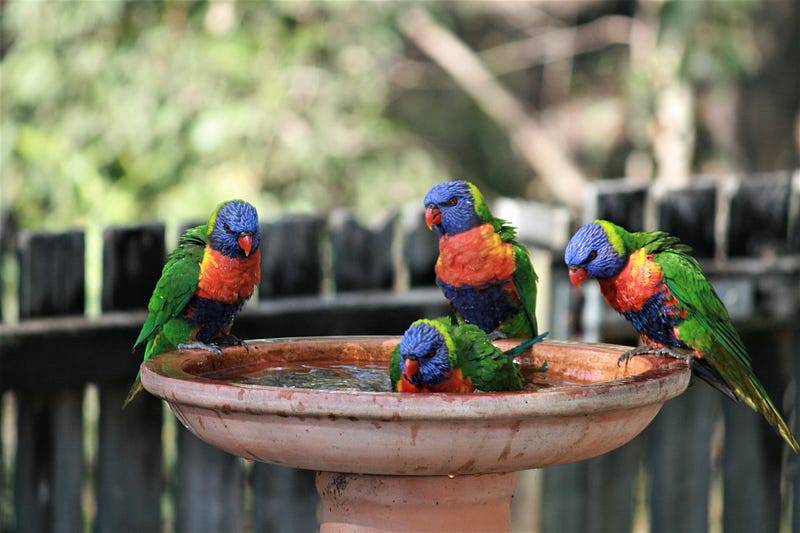
The photo was taken on August 17th, 2019 and shows Rainbow Lorikeets (Trichoglossus moluccanus) enjoying our birdbath in the middle of the drought that killed a lot of my plants. It was wonderful to see the birds enjoying the water we provided when things were so dry. Now, of course, we’re waterlogged following flooding, but that’s Australia!
I love a sunburnt country,
A land of sweeping plains
Of ragged mountain ranges,
Of droughts and flooding rains.
I love her far horizons,
I love her jewel sea
Her beauty and her terror,
The wide brown land for me.
Dorothea Mackellar (My Country) — written in 1906
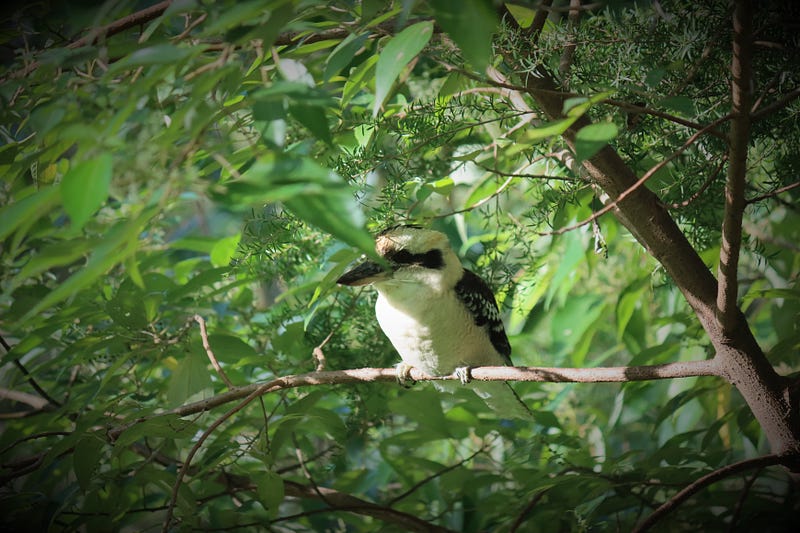
The only photo I got on April Fool’s Day was this Kookaburra (Dacelo novaeguineae) sitting in the Native Mulberry (Pipturus argenteus) hunting. It was amusing to see such a large bird in this small tree. Usually, the birds in its branches are smaller and more interested in its tiny white berries.
Kookaburra sits in the old gum tree
Merry, merry King of the Bush is he!
Laugh Kookaburra
Laugh Kookaburra
Gay your life must be!
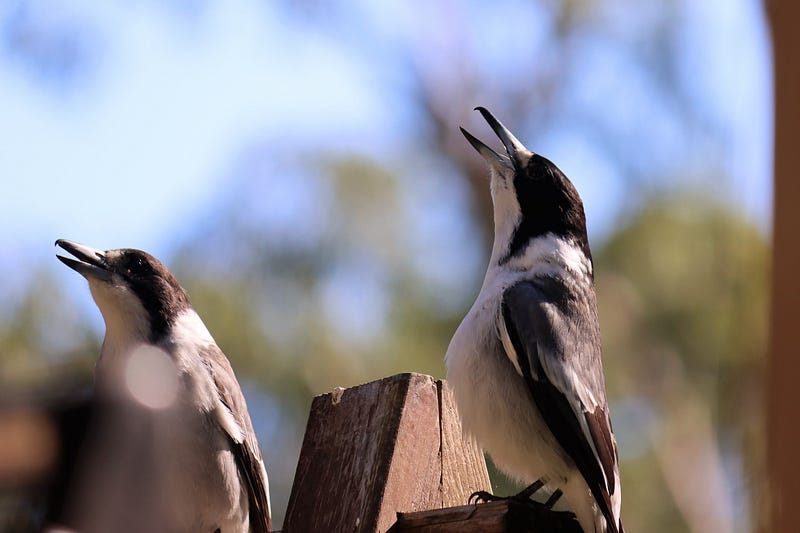
These two Grey Butcherbirds (Cracticus torquatus) sing in our garden all the time and their song is utterly beautiful and bewitching. However, they are called Butcherbirds for a reason! They are relentless hunters picking on the weak and hanging them from sticks or thorns to tenderise the flesh of their prey.
Never yet had siren sung
From a falser heart than mine,
Witness these grim trophies hung
Round me, while a cadence fine
Ripples on the balmy air
To the Fall’s soft winds astir,
While anew I set my snare
For some feathered voyager.
CJ Dennis (The Butcher Bird) written in 1935
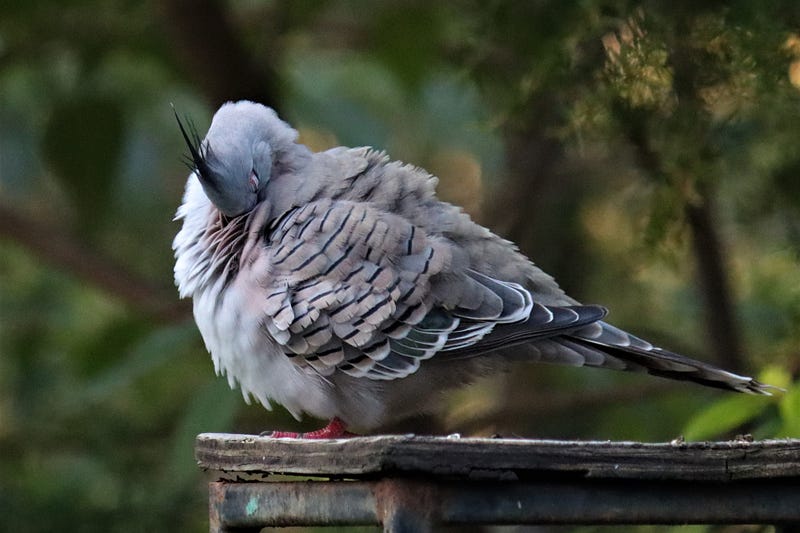
Cressy, our Crested Pigeon (Ocyphaps lophotes) friend is spending more and more time with us lately. He seems to have finally decided that we are “safe” and therefore he can sit near us and enjoy the sun or groom. The following poem is about Bronzewing Pigeons, but it suits these guys too.
They say I am a shy, wild thing,
That seeks the wild bush glade,
Quick to be gone on whirring wing,
Where strangers should invade;
But well I know what all birds know —
The voice of friend, the tread of foe;
And deem it wise to fear the worst
Till I have knowledge of you first.
CJ Dennis (The Bronzewing Pigeon) written in 1935
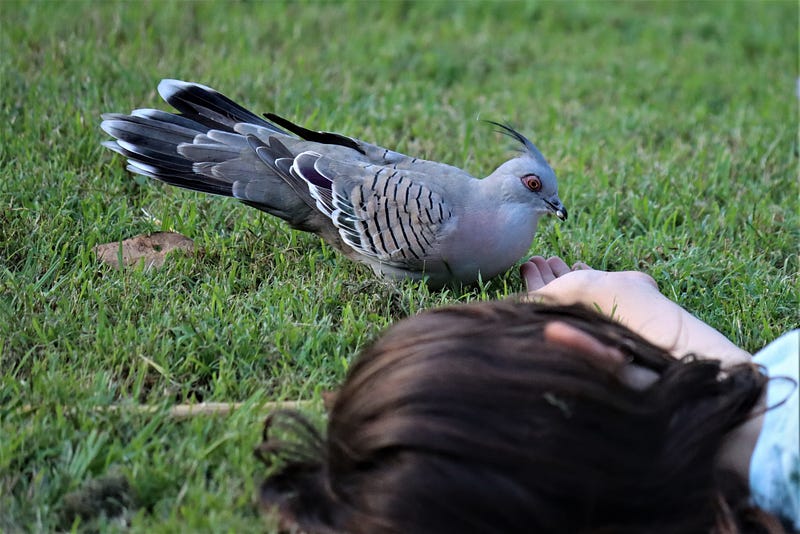
The next day my daughter wanted to see how close Cressy would get so she laid on the grass with a handful of sunflower seeds. He didn’t disappoint and walked all around her when the seeds had run out.
But should you win me in the end
By dint of kindlier lore,
Gladly I take you for a friend,
And to your own house door
I come with confidence complete
To quest my food about your feet…
CJ Dennis (The Bronzewing Pigeon) written in 1935
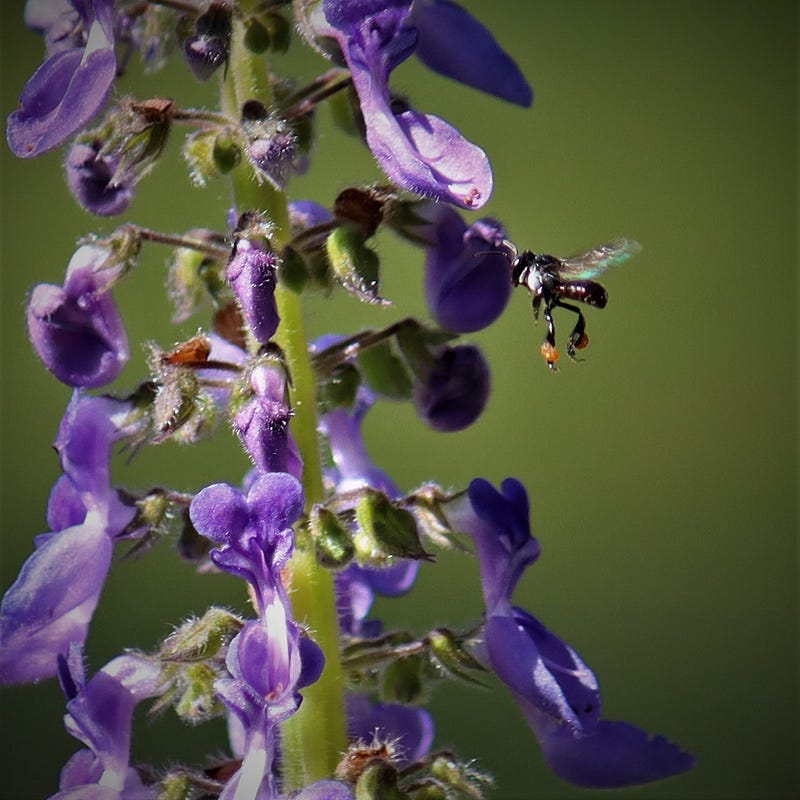
This tiny Stingless Bee (Tetragonula sp.) is only about 3mm (0.11 inch) long. It was gathering nectar from a Bush Basil (Coleus graveolens) and this is one of about a dozen photos. They are so small and fast it’s hard to get them in focus. They are a social species and their Bush Honey currently retails for about $A25 for just 50grams (1.7 ounces). This is because each hive only produces around one kilogram (2.2 pounds) in a year.
From the hollow trees in their native home
them old fellows cut the honeycomb.
On honey and little white grubs they fed,
’cause them young bees was blackfeller’s bread.
…
Naked through the bush they went,
an’ never knew what sickness meant,
them native bees could do you no harm,
they’d crawl all over your honey-smeared arm.
Roland Robinson from the words of Aboriginal man, Percy Mumbulla (Bees) written in 1970
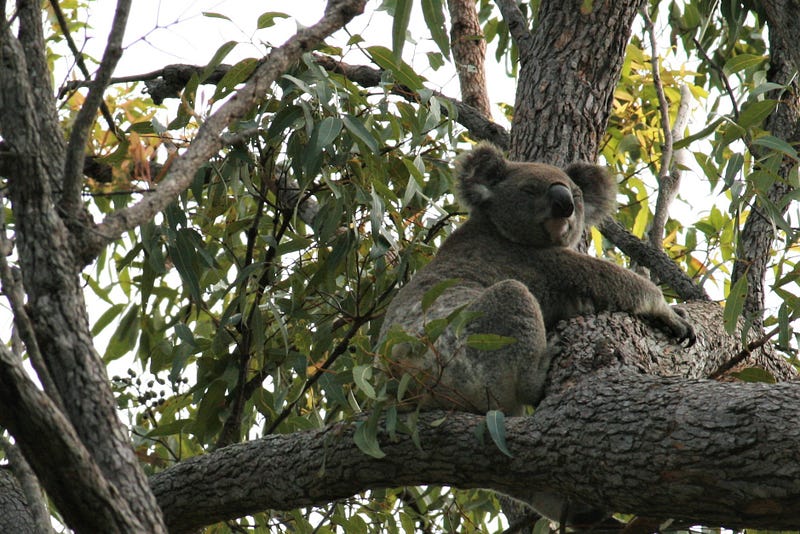
This photo was taken in December 2018 and to this day it is the only time we have seen a Koala (Phascolarctos cinereus) on our block of land. Having said that, we checked on him all day and had trouble finding him, even though we knew he was there so we could have had more visits and simply missed seeing him. Bear is actually inaccurate for this species as they are most closely related to Wombats.
If you’d like to know more about this Aussie icon, I have a draft in progress, written in response to this story from fellow Australian writer, Adrienne Beaumont.
Then he found a fork, where he swayed in air
As he gripped the boughs like a native bear.
Banjo Paterson (A Change of Menu) written in 1933
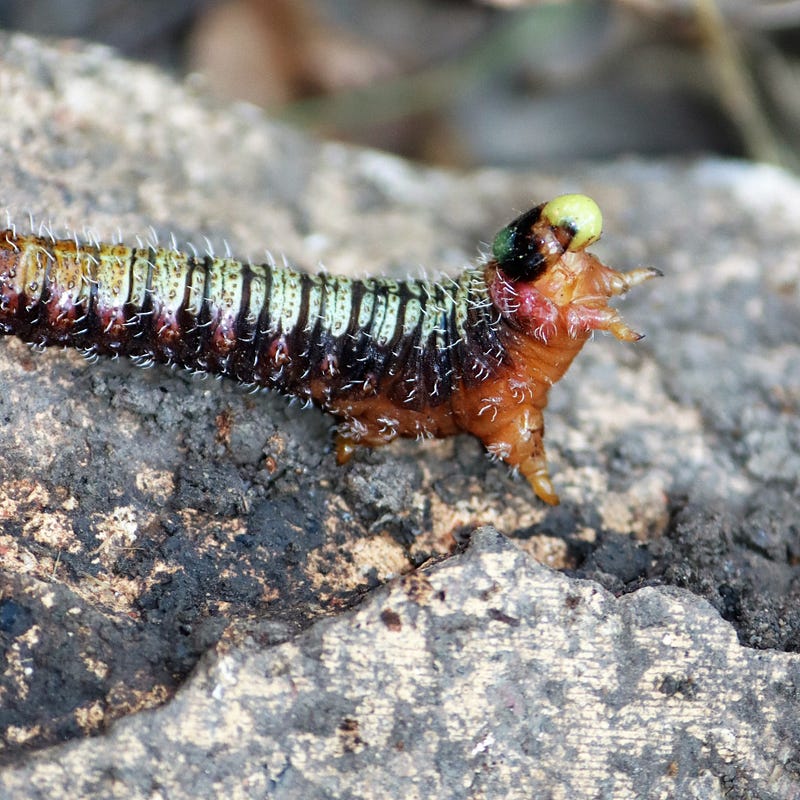
This amazing creature was unearthed by my son lifting a rock. It is sawfly larvae and it’s about to pupate. That yellow bubble of goo is its defence mechanism which is an acidic liquid that stings if touched. They are sometimes called spitfires due to this stinging goo, but it would be more accurate to call them dribblefires as they don’t spit the liquid.
They feed on leaves in large groups. In a bumper breeding season, they can defoliate a whole gum tree. Fascinating creatures, that haven’t changed in millions of years and are believed to be closely related to the ancestors of modern-day bees and wasps.
I planted here, to-day, a strong young tree.
Rich soil it has, and sun, and space to grow;
And who, I wonder, in the years to be
Will seek its boughs’ soft shade; for well I know
Long ere this slender plant grows full and round
He who now tends it shall be sleeping sound.
CJ Dennis (The Tree) written in 1935
It’s been a treat to connect these images to poetry, and now I’d like to finish with the same poet from the start… ah if only I could wax lyrical like Dorothea…
An opal-hearted country,
A wilful, lavish land –
All you who have not loved her,
You will not understand –
Though earth holds many splendours,
Wherever I may die,
I know to what brown country
My homing thoughts will fly.
Dorothea Mackellar (My Country) written in 1906
I challenge you, dear reader, to take up the gauntlet and connect your own images to famous poems. It’s lovely to revisit the words of the past and see how they connect to the light of the present!
Like to motivate Jane to keep creating? Buy her a coffee using this link. Or help her monetise her YouTube channel by subscribing and/or watching some of her videos.


